

Exercising safely for knee and hip pain
Defence Force training, exercises and deployment can place significant strain on some veterans’ lower body, leading to the development of knee and hip pain.

New Year’s resolutions aren’t a new concept, but harnessing the motivation behind them to set and track simple goals can help improve your health and wellbeing.
The “Fresh Start Effect” is the idea that a new time marker (like the new year) motivates people to commit to and pursue goals that promote positive behaviour changes, helping to combat old patterns.
Common examples include signing up for a gym membership, beginning a new diet or even creating a new budget.
By taking advantage of this motivation, you can work towards building out achievable goals for yourself, instead of resolutions, with the intention of improving your overall health and wellbeing.
Resolutions vs. goals
Making the decision to have New Year’s resolutions can be a great start to deciding to take care of your health and wellbeing, but setting goals can increase your likelihood of achieving them.
This is because a resolution tends to be a broad intention (e.g., “I’ll get fitter”, “I’ll fix my knee”, “I’ll lose weight”), whereas a well‐set goal is specific, measurable, time‐bound and actionable.
For example, rather than a resolution such as, “I’ll be more active”, a goal would be, “I will attend two physiotherapy sessions for my knee by end of February and then walk for 30 minutes, three time a week, for 8 weeks.”
For veterans or current-serving personnel who often face unique physical health challenges – musculoskeletal injuries, transition to civilian life, changing fitness demands or possible service‐related wear and tear – a goal-orientated framework helps channel motivation into meaningful physical health improvements.
How to set realistic goals (and stick to them!)
Setting goals doesn’t need to be complicated – the simpler the better.
Maintaining motivation to build discipline
Once you’ve built out your goals, the next step is to ensure you maintain that motivation and discipline from the beginning of the year to track and achieve them.
While your motivation is high, use the early part of the year to schedule a health check or allied health consultation with a physiotherapist or exercise physiologist
Then, link that appointment to a clear goal such as, “By March I’ll get on top of this knee pain, so I can train pain-free for the year ahead.”
From there, some simple ways to keep on top of your goals include:
Another way to stay disciplined is remembering that by meeting your physical health goals, this can improve your mental health too.
Tracking your goals and seeing progress will boost your confidence and promote a sense of accomplishment. Plus, moving your body helps to reduce stress and lift your mood, which can then help boost your motivation to keep going.
Support at Mates4Mates
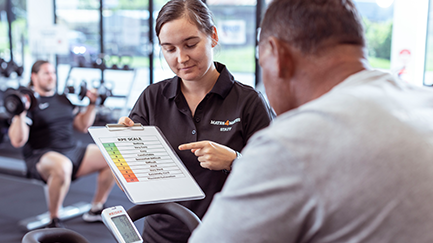
If you’ve made a goal this year to improve your physical health, then the Mates4Mates physical rehabilitation team is here to help you.
The team comprises of physiotherapists and exercise physiologists who can support veterans and their families to improve their health and wellbeing through one-on-one appointments and group exercise classes.
They can also support with developing an achievable goal framework that considers your barriers and resources while understanding the challenges of military life.
Mates4Mates also provides mental health services, with appointments available to speak with a psychologist, counsellor or social worker to further support you.
To find out more about how Mates4Mates can help support you, reach out to us on 1300 4 MATES (62 837) for a confidential chat.
Written by Baxter Mahutonga, Mates4Mates Clinical Lead – Physical Rehabilitation and Physiotherapist
Defence Force training, exercises and deployment can place significant strain on some veterans’ lower body, leading to the development of knee and hip pain.